

Schema Markup for Dental Websites: The Hidden Code That Makes AI Trust You
There's a good chance your dental website has a problem you can't see.
Not a broken link. Not a slow load time. Not a missing page. Something invisible — literally invisible to anyone looking at your website the normal way. But to AI tools like ChatGPT, Google's AI Mode, and Perplexity, this invisible layer is one of the clearest signals of whether your practice is worth recommending.
It's called dental schema markup. And if your web team has never brought it up, there's a solid chance your site either has very little of it or none at all.
This post explains what schema markup actually is in plain English, why it matters specifically for AI search visibility, the four schema types your dental website needs right now, and how to check in about 60 seconds whether your site has any at all.

What Is Dental Schema Markup, in Plain English?
Your website has two audiences: human visitors and machines — specifically, search engines and AI tools.
For human visitors, your content speaks for itself. Someone reads your dental implant page and understands you're a dentist who does implants in Dallas. They see your phone number. They read your reviews section. They understand the context entirely.
For machines, it's a different story. Search engines and AI tools are very good at reading text, but they often have to guess at context. Is this business a dentist or an oral surgeon? Is this number a price or a phone number? Is this paragraph answering a patient question or describing a staff member? Without additional context, machines interpret rather than understand — and interpretation introduces uncertainty.
Schema markup eliminates that uncertainty.
At its core, schema is a standardized vocabulary of labels — written in code that sits on your web page but never appears to a visitor — that tells machines exactly what your content means. It's the difference between a machine reading "Dr. Sarah Chen, DDS, serving the Austin area for over 15 years" and having to guess what that means, versus reading a clean, structured signal that says: This is a licensed dentist. Her name is Sarah Chen. She is located in Austin, Texas. These are her specialties. This is her phone number. These are her hours.
Schema markup is essentially a translator between your human-readable website and the machine-readable understanding that AI tools rely on to generate confident recommendations.
The phrase "makes AI trust you" in the title isn't marketing language. It's literally what happens. When your content is labeled clearly and correctly with schema, AI tools don't have to guess at what you are, where you are, or what you offer. They know. And what they know with confidence, they're far more likely to recommend.
The 4 Schema Types Every Dental Website Needs
Not all schema is created equal, and not all of it is equally relevant for dental practices. Here are the four types that matter most — what each one does and why it belongs on your site.
1. LocalBusiness / Dentist Schema
This is the foundational layer, and if your site has any schema at all, it's probably this one — though it may be incomplete.
Dentist schema (a subtype of LocalBusiness) communicates the essential facts about your practice: your official name, your street address, your city and state, your zip code, your phone number, your hours of operation, your website URL, and your geographic service area. It can also include your price range, accepted payment methods, and the languages your staff speaks.
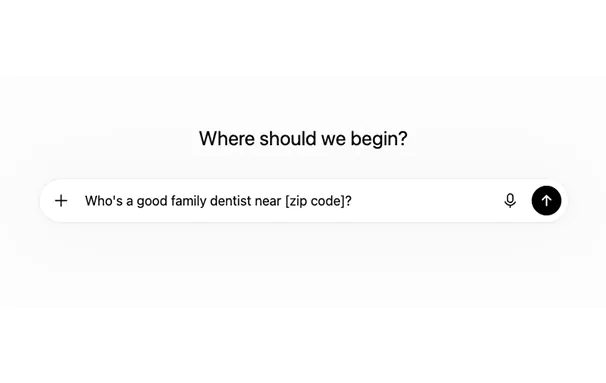
Why does this matter for AI specifically? When ChatGPT or Google's AI Mode gets a location-based question — "Who's a good family dentist near [zip code]?" — it's drawing on structured location data to generate a response. A practice with clean, complete Dentist schema gives the AI a clear, unambiguous signal about where you are and who you serve. A practice without it forces the AI to infer that information from text — which is less reliable and less likely to result in a recommendation.
2. FAQPage Schema
This one is criminally underused in dental marketing, and it's arguably the highest-impact schema type for AI search visibility specifically.
FAQPage schema wraps around your FAQ sections — the question-and-answer blocks we talked about in the previous blog in this series — and tells machines: These are discrete questions and their corresponding direct answers. They are citable as standalone content.
Without FAQPage schema, your FAQ section is just text on a page. With it, each question and answer becomes a labeled, structured data point that AI tools can reference, extract, and cite individually. When a patient asks ChatGPT "Does Invisalign hurt?", an AI tool with access to a properly schema-tagged FAQ that answers exactly that question has a much clearer path to pulling that answer — and attributing it to your practice.
This is the closest thing to a direct line between your website content and an AI recommendation.
3. MedicalProcedure Schema
This is the one most dental websites are missing entirely, and it's becoming increasingly relevant as AI tools get more sophisticated about healthcare searches.
MedicalProcedure schema allows you to tag individual service descriptions — dental implants, Invisalign, teeth whitening, root canals — with structured labels that identify them as medical procedures, describe what they involve, indicate who they're appropriate for, and connect them to your practice as the provider.
Think of it as the difference between your implant page being machine-readable as "a web page about something called dental implants" versus "a page describing a specific medical procedure performed by a licensed dental provider at this specific location." The second version is what gives AI tools the confidence to include your practice in a response to a highly specific procedure-based question.
4. Review / AggregateRating Schema
You've worked hard to earn your Google reviews. Review schema makes sure that work gets credited in AI search the way it should.
AggregateRating schema communicates your overall rating, the number of reviews you've received, and the platform where those reviews live — all in a structured format that AI tools can read directly rather than scraping and interpreting from a review page.
When an AI tool is evaluating whether your practice is credible enough to recommend, review data is one of the most meaningful trust signals it has. Review schema makes that data unambiguous. It's the structured way of saying: "This practice has 218 verified patient reviews with an average rating of 4.8 out of 5." That's a very different signal than a machine guessing at your rating from text on a page.
How to Check If Your Site Has Schema in 60 Seconds
Before you do anything else, find out where your site stands right now. Here's how:
- Go to search.google.com/test/rich-results in your browser — it's Google's free Rich Results Test tool, and it requires no login.
- Enter your website's homepage URL and click "Test URL."
- Wait about 15 seconds for the results to load.
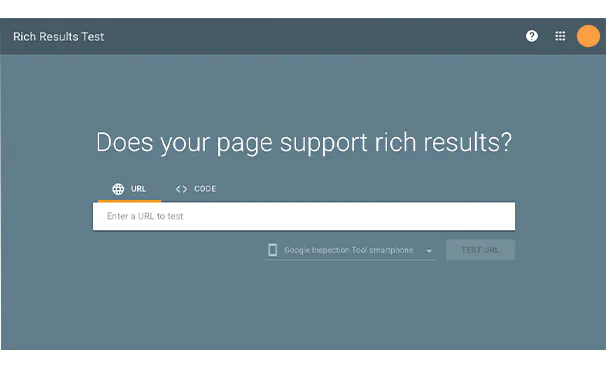
What you're looking for: a list of detected structured data types on your page. If you see items like "LocalBusiness," "FAQPage," or "Dentist" listed — good, you have something to build on. If the results come back empty or show only one basic schema type with missing fields — you've just identified a gap that's very likely affecting your AI visibility right now.
You can also run this test on individual service pages, not just your homepage. Your implant page and Invisalign page are worth checking separately, since those are the pages most likely to be referenced in AI responses to procedure-specific questions. Don't assume that because your homepage has schema, your service pages do too — they often don't.
If the results are thin, that's not a crisis. It's a to-do item for your web team or dental marketing partner. Adding schema is a technical change to existing pages, not a rebuild — most of it can be done without touching your visible content at all.
The 3 Schema Mistakes That Make AI Ignore Your Site
Having some schema is better than having none. But there are three common mistakes that neutralize the benefit even when a dental site has made an attempt at implementation.
Mistake 1: Incomplete LocalBusiness schema. The most common version of this is a practice that has their name and phone number in schema but is missing their address, service area, or hours. Incomplete schema is still useful, but it leaves gaps that undermine the confidence signal it's supposed to create. AI tools trying to answer a location-based question need complete location data. Partial data creates partial confidence — and partial confidence often means no recommendation.
Mistake 2: FAQPage schema that doesn't match the on-page content. This happens when schema is added to a page but isn't kept in sync with the actual text. If your schema tags say the answer to "How long does Invisalign take?" is "12 to 18 months" but your page copy says "treatment time varies by patient," there's a mismatch. AI tools and search engines notice discrepancies between structured data and visible content, and they treat those discrepancies as a credibility problem — not a recommendation signal.
Mistake 3: Using schema types that don't match your content. Not every schema type is appropriate for every page. Tagging a blog post with MedicalProcedure schema, or applying LocalBusiness schema to a service page, creates noise rather than clarity. Schema works best when the type precisely matches the content it's labeling. Mismatched schema can confuse AI tools rather than guide them — which is worse than having no schema on that page at all.
What a Properly Schema-Tagged FAQ Block Looks Like vs. a Regular One
Here's the practical difference, without getting too deep into the code.
A regular FAQ block on a dental website looks like this to a human — and to a machine without schema:
Does getting a dental implant hurt? Most patients are surprised by how manageable the procedure is. We use local anesthesia during placement, and most patients describe the discomfort afterward as similar to a tooth extraction — manageable with over-the-counter pain relief for the first few days.
That's solid content. But to a machine, it's just a heading followed by a paragraph. Without schema, there's no explicit signal that this is a question-and-answer pair designed to be cited.
With FAQPage schema properly applied, the same content becomes machine-readable as a structured pair:
- Question: "Does getting a dental implant hurt?"
- Answer: "Most patients are surprised by how manageable the procedure is. We use local anesthesia during placement, and most patients describe the discomfort afterward as similar to a tooth extraction — manageable with over-the-counter pain relief for the first few days."
The content is identical. But the structured version tells AI tools explicitly: This is a question. This is its direct answer. They belong together. This content is designed to be referenced.
Google even surfaces properly schema-tagged FAQs directly in search results as expandable rich snippets — meaning the question and answer appear right in the search results page before a user ever clicks. The AI search benefit is the same principle taken one step further.
A Note on Keeping Schema Current
Schema isn't a one-time project. It needs to stay in sync with your actual practice information as things change. When you add a new service, update your hours, move locations, or significantly revise a service page — your schema should be updated at the same time.
Stale schema is nearly as problematic as missing schema. An AI tool that finds structured data claiming your practice is open on Sundays when you haven't been open on Sundays in two years has a trust problem with your site — even if everything else is in order. Build schema maintenance into the same workflow as any other website update. It doesn't require much time, but it does require consistency.
The Bottom Line on Schema for Dental AI Search
Schema markup isn't glamorous. It doesn't change how your website looks. Your patients will never see it directly. But the AI tools that are increasingly shaping which dental practices patients discover and call — they see it clearly. And it matters more than most dental marketing conversations acknowledge.
A dental website with complete, accurate, well-maintained schema has a structural advantage in AI search that good copywriting alone can't fully compensate for. It's the technical foundation that makes everything else — your content depth, your FAQ sections, your review volume — legible to the machines deciding who to recommend.
If you've done the content work and you're still not showing up in AI responses the way you'd expect, schema is almost certainly part of the answer. And now you know how to check.
Our free ChatGPT guide doesn't just explain schema — it includes four specific prompts you can use to generate the schema markup for your own dental service pages, even if you've never written a line of code. Find the complete walkthrough here: How to Make Your Dental Practice Show Up in ChatGPT.
For a comprehensive review of your site's current technical foundation — schema, site structure, content depth, and everything in between — our dental SEO and dental website design teams at Firegang are ready to show you exactly where the gaps are and what it looks like to close them. Contact us today to schedule a complimentary practice growth assessment with our team.