

Can AI Chatbots Like ChatGPT Actually Send Me Dental Patients?
If you've used ChatGPT, Claude, or Perplexity recently, you've probably noticed something changing about how people search for information. Instead of simply typing "dentist near me" into Google, patients can now ask AI assistants detailed questions about dental services, pricing, insurance, and local practices.
But can AI chatbots for dentists actually lead to more new patients?
The short answer is yes, potentially. AI tools like ChatGPT can help patients discover dental practices, compare treatment options, and make more informed decisions about where to schedule an appointment. However, appearing in AI search results doesn't automatically translate into booked appointments.
For dental practice owners, the real opportunity is understanding how AI assistants discover, evaluate, and recommend dental practices and how to make your practice easier to find.
Here's what dentists need to know about turning AI search visibility into opportunities for new patient growth.
How Can AI Chatbots for Dentists Generate New Patients?
AI search for dental practices doesn't work like a paid ad or even a traditional Google search result. There's no "AI SEO button" you can pay to push your practice to the top. Instead, AI assistants pull from a mix of sources: your dental website content, your Google Business Profile, review platforms, local directories, and increasingly, blog content that directly answers the kinds of questions people are asking.
When someone asks ChatGPT "why isn't my dentist calling me back after I book online," or "what should I ask before choosing a sedation dentist," AI is looking for the clearest, most specific, most trustworthy-sounding answer it can find. If your practice has published content that actually answers that exact question (not generic "top 10 tips" content, but a real, specific answer), you have a much higher chance of being the source that gets referenced, or even the practice that gets named.
That's the mechanism. It's not magic, and it's not instant, but it's real.
Why AI Search Matters for Dental Patient Acquisition
Dental care is exactly the kind of decision people research carefully before committing to. They want to know about pricing, insurance, sedation options, emergency availability, and reviews, often several of these at once. That's a lot of specific questions, which means it's a lot of opportunity for AI assistants to surface a practice that has clearly, directly addressed those questions in its content.
Compare that to a business with vague, generic web copy ("We provide quality dental care for the whole family"). That kind of content gives an AI assistant nothing specific to pull from. It's not going to get referenced for a specific question because it never actually answered one

How Dental Practices Appear in ChatGPT and AI Search
There isn't a single ranking page like there is with Google. Instead, showing up well in AI search tends to happen in a few ways:
- Direct citation. The AI mentions your practice by name in its answer.
- Content reuse. The AI paraphrases information from your dental website (a pricing range, a policy, an answer to a common concern) without necessarily naming you, but the information itself came from your content being well-structured and specific.
- Increased branded searches. People ask AI a question, get a general answer, then go search your practice name directly because your content came up as a reference point somewhere in their research.
All three of these are valuable. The third one in particular is easy to underestimate, but it often shows up first as an uptick in direct or branded traffic before you ever see your name explicitly mentioned in an AI response.
4 Ways to Improve Your Dental Practice's AI Search Visibility
This is where a lot of the mystery clears up, because the fundamentals aren't that different from good dental SEO. They're just applied with a sharper focus on specificity.
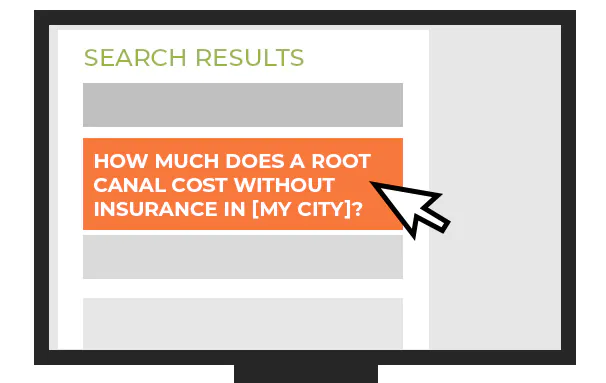
- Answer real, specific questions, not generic topics. "Top 5 Reasons to See a Dentist" won't get picked up by an AI assistant, because it doesn't answer anything a person actually typed in. "How Much Does a Root Canal Cost Without Insurance in [Your City]" is the kind of specific, long-tail question people ask AI directly, and the kind of content AI tools are built to surface.
- Keep your Google Business Profile and website details consistent and current. AI assistants cross-reference multiple sources. If your hours, services, and location details are inconsistent across your dental website, GBP, and directory listings, it creates uncertainty that makes AI tools less likely to cite you confidently.
- Structure content so it's easy to extract. Clear headers, direct answers near the top of a page, and plainly stated facts (pricing ranges, service availability, insurance accepted) are far easier for an AI model to pull from than long, marketing-heavy paragraphs that bury the actual answer.
- Build genuine topical authority, not just volume. A handful of genuinely useful, specific posts that thoroughly answer real patient questions will outperform a large volume of thin, generic content. AI models are trained to favor substance and specificity over sheer word count.
Why Dental SEO Still Matters for AI Search
This isn't a replacement for traditional SEO. It's a layer on top of it. The practices that are already investing in solid dental SEO (clear site structure, strong local signals, genuine expertise reflected in their content) are the ones best positioned to benefit as AI search grows, because the underlying inputs are so similar. Our dental SEO approach is built with this in mind, creating content that answers real patient questions specifically enough to perform well in both traditional search and AI-driven search, rather than treating them as two separate strategies.
Can ChatGPT Actually Help Your Dental Practice Get More Patients?
Not in the sense of an ad campaign with a clear click-to-call button. But in the sense of shaping how potential patients research, compare, and eventually choose a practice, yes, increasingly so. The practices showing up in these AI conversations today are the ones that got specific early, while most of their competitors are still publishing generic content that no AI assistant has any reason to reference.
If you're not sure whether your current content is set up to be found this way, that's worth a real look, not guesswork.
Book a Free Practice Growth Call with our team at Firegang Dental Marketing to see where your practice currently stands in AI and traditional search alike, and what it would take to close the gap.