

How to Choose a Dental PPC Agency: What to Ask and What They Should Report
Choosing the right dental PPC agency starts with three important factors: how they track calls and booked appointments, who owns your Google Ads account, and what their monthly reports actually show. Before comparing fees, make sure the agency can explain how its advertising efforts translate into real opportunities for your dental practice.
If you're considering hiring a dental PPC agency or questioning whether your current agency is delivering results, you're probably wondering: Is my advertising actually helping me get more new patients?
It's an important question. Google Ads can be a powerful way to reach people actively searching for dental services, but getting someone to click on an advertisement is only the beginning.
What happens after that click is what really matters.
Some marketing agencies focus heavily on website traffic, impressions, and clicks. Others look at the bigger picture, including the quality of incoming calls, how many prospective patients schedule appointments, and whether your advertising is supporting your practice's growth goals.
Understanding the difference can help you make a more informed decision about who manages your dental advertising.
Here's what to look for, which questions to ask, and what you should expect from a dental PPC agency.
What Does a Dental PPC Agency Actually Do?
A dental PPC agency manages paid advertising campaigns designed to connect dental practices with potential patients searching for dental care online.
PPC stands for pay-per-click, meaning advertisers typically pay when someone clicks on their advertisement.
For example, someone searching Google for "emergency dentist near me" or "dental implants in Atlanta" may see paid advertisements appearing in their search results.
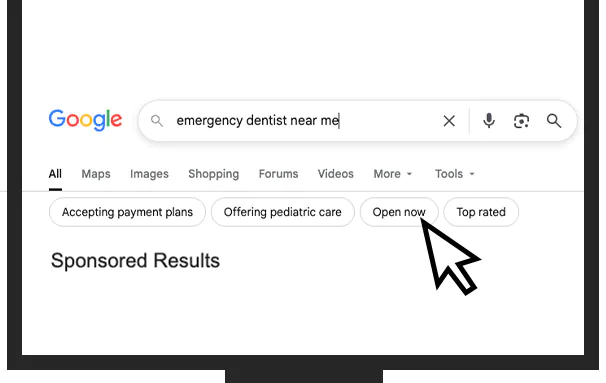
The agency's responsibility is to help your practice appear for relevant searches while turning that visibility into meaningful patient opportunities.
A qualified dental PPC agency should manage several important aspects of your advertising strategy, including:
- Campaign setup and organization: Creating campaigns around specific dental services, practice locations, and growth goals.
- Keyword research: Identifying relevant searches that potential patients are using.
- Negative keywords: Helping prevent advertisements from appearing for irrelevant searches that could waste your advertising budget.
- Ad copy: Writing compelling, accurate advertisements that communicate what makes your practice different.
- Landing pages: Directing prospective patients to relevant pages that encourage them to contact your office.
- Conversion tracking: Measuring incoming calls, contact forms, and other meaningful patient inquiries.
- Campaign optimization: Regularly reviewing performance and making adjustments to improve results.
- Performance reporting: Providing clear updates about advertising spend, patient inquiries, and campaign performance.
Effective dental PPC services should involve much more than launching advertisements and hoping for the best.
Your agency should understand which services you want to grow, the types of patients you're trying to attract, and how your advertising fits into your overall practice goals.
What Questions Should You Ask a Dental PPC Agency Before Hiring?
When comparing agencies, it's easy to be impressed by a polished presentation or promises of increased website traffic.
But the most important information often comes from asking a few straightforward questions.
Here are eight questions every dentist or office manager should ask before choosing an agency.
1. Who Owns Our Google Ads Account?
Your dental practice should generally own its Google Ads account and retain administrative access.
The agency can manage your campaigns through authorized access, but you should maintain control over your account, billing information, and advertising history.
Be cautious if an agency insists on keeping everything under its own account without giving your practice appropriate access.
2. How Do You Track Calls and Patient Inquiries?
A good agency should be able to explain exactly how it measures the responses generated by your advertisements.
That may include phone calls, contact form submissions, appointment requests, and qualified leads.
Simply tracking clicks doesn't tell you whether people are actually contacting your practice.

3. How Do You Know Which Ads Generate New Patients?
This is one of the most valuable questions you can ask.
An agency should understand the difference between someone clicking an advertisement, calling your office, scheduling an appointment, and becoming a patient.
Although not every practice has the systems needed to connect each step automatically, your agency should be transparent about what it can measure and what remains unknown.
4. What Will Our Monthly Reports Include?
Ask to see an example report before signing a contract.
A useful report should explain your advertising spend, incoming inquiries, conversion activity, and campaign performance.
Ideally, it should also connect those metrics to booked appointments when that information is available.
5. How Will You Structure Our Campaigns?
Dental advertising shouldn't be treated as a one-size-fits-all strategy.
Someone searching for emergency dental care has different needs than someone researching implants or cosmetic dentistry.
Ask how the agency organizes campaigns by dental service, location, and patient search intent.
6. Who Will Actually Manage Our Advertising?
You should know who is responsible for monitoring and optimizing your campaigns.
Ask whether you'll have a dedicated contact, how often campaigns are reviewed, and how frequently you can expect communication.

7. What Happens If We Decide to Leave?
Before entering an agreement, understand the contract terms and cancellation process.
Will your practice retain access to its advertising account, campaign data, and tracking information?
A reputable agency should be upfront about what happens if you decide to make a change.
8. How Do You Handle Healthcare Advertising Policies?
Dental advertising has requirements that may not apply to other industries.
Ask whether the agency is familiar with Google's healthcare advertising policies and how it reviews campaign messaging, targeting, and conversion tracking for compliance.
An agency experienced in dental marketing should be able to discuss these considerations confidently.
Why Conversion Tracking Matters More Than Clicks
One of the biggest mistakes dental practices can make when evaluating Google Ads performance is focusing too heavily on clicks.
Imagine your advertisements are generating plenty of website visitors.
At first glance, that sounds like a success.
But what if those visitors aren't contacting your practice? Or what if your office is receiving calls, but very few of those callers schedule appointments?
A report filled with impressive traffic numbers doesn't necessarily mean your marketing is performing well.
That's why choosing a dental Google Ads agency that understands conversion tracking is so important.
Understanding the Difference Between Clicks, Leads, and New Patients
These terms are often used when discussing PPC performance, but they represent very different outcomes.
Clicks: Someone clicks on your advertisement. This indicates interest but doesn't mean the person contacted your office.
Leads: Someone takes an action, such as calling your practice or submitting a contact form. Not every lead is necessarily a qualified new patient opportunity.
Booked Appointments: A prospective patient schedules an appointment with your practice. This provides a clearer indication of whether your advertising is contributing to your schedule.
New Patients: Someone attends their appointment and becomes a patient of your practice.
The closer your tracking gets to actual appointment and patient outcomes, the better you can understand the value of your advertising efforts.

What Is Offline Conversion Tracking?
Offline conversion tracking helps connect online advertising activity with actions that occur outside the website.
For example, someone might click your Google advertisement, call your office, and schedule an appointment.
With the appropriate tracking systems in place, certain qualified lead or appointment events can be imported back into Google Ads.
This gives the advertising platform additional information about which interactions are generating more meaningful outcomes.
Google provides guidance on offline conversion imports, including methods for connecting eligible offline events with advertising activity.
It's important to understand that these tracking capabilities depend on the systems being used and must be implemented with appropriate privacy protections.
Still, your agency should be able to explain whether this type of tracking is possible for your practice and how it could improve campaign measurement.
You can learn more about the importance of measuring meaningful results in our guide to tracking and analyzing dental PPC performance.
Don't Overlook Call Tracking
For many dental practices, the phone is one of the most important connections between marketing and new patient acquisition.
But not every call represents a potential new patient.
Some calls come from existing patients. Others may involve insurance questions, unrelated inquiries, or prospective patients who never schedule an appointment.
Call tracking can help determine which inquiries originate from advertising campaigns.
When legally permitted and appropriately configured, call recordings and call quality evaluations can also provide insights into how those inquiries are handled.
Practices should confirm applicable recording consent requirements and patient privacy obligations before implementing these tools.
A strong agency should want to understand what happens after someone contacts your practice, not simply report that the phone rang.
Who Should Own Your Dental Google Ads Account?
Account ownership is an important consideration that dentists sometimes overlook when choosing a marketing agency.
Your practice should generally retain ownership and administrative access to its Google Ads account.
The agency can be granted permission to manage campaigns without taking ownership of the account itself.
Why is this important?
Imagine you've worked with an agency for several years and decide it's time for a change.
If the agency controls your account and won't provide access, you may lose valuable campaign history, performance information, and the ability to continue working within the same advertising account.
That can make transitioning to another provider more complicated than necessary.
Before signing an agreement, confirm that your practice will maintain access to its account, understand who controls billing, and know what happens to advertising data if the relationship ends.
Transparency should be a basic expectation, not something you have to negotiate.
What Should a Dental PPC Report Include?
If you're investing in Google Ads, you deserve to understand what that investment is doing for your practice.
A monthly report shouldn't require you to be a digital marketing expert to understand it.
It should explain what happened, what results were generated, and what your agency plans to improve.
Here are the key metrics to look for in a dental PPC report.
| Metric | What it tells you |
| Advertising Spend | How much your practice invested in Google Ads during the reporting period. |
| Clicks and Impressions | How many people saw and interacted with your advertisements. |
| Phone Calls and Form Submissions | How many tracked inquiries came through your advertising campaigns. |
| Qualified Leads | How many inquiries represented relevant potential patient opportunities. |
| Booked Appointments | How many tracked inquiries resulted in scheduled appointments, when measurable. |
| Cost Per Lead | How much advertising spend was required to generate a tracked lead. |
| Cost Per Booked Appointment | How efficiently advertising generated scheduled appointments, when trackable. |
| Campaign Performance | Which dental services and advertising campaigns generated the most meaningful activity. |
| Search Terms | Which available search queries triggered your advertisements. |
| Next Steps | What changes the agency made and what it plans to improve. |
The best reports do more than present numbers.
They explain what those numbers mean for your practice.
For example, if calls increased but booked appointments remained flat, that could indicate an opportunity to examine lead quality, scheduling availability, or how inquiries are handled by the front desk.
If a particular dental service is attracting relevant inquiries, your agency should be able to explain whether there are opportunities to build on that performance.
You should also expect comparisons with previous reporting periods and clear explanations of meaningful changes.
A good monthly report should leave you feeling informed, not confused.
How Do Dental PPC Agency Fees Work?
Understanding how an agency structures its management fees can help you compare different providers.
There are three common approaches.
Flat Management Fees
Some agencies charge a consistent management fee for overseeing advertising campaigns.
This creates a predictable management arrangement, although it's important to understand which services are included.
Percentage of Advertising Spend
Other agencies calculate their management fee as a percentage of the amount spent on advertising.
Under this structure, management fees may increase as your advertising budget grows.
Initial Setup Fees
Some agencies also charge an initial setup fee for campaign development, tracking configuration, or related work.
This may be combined with either of the ongoing management structures.
Regardless of the fee model, your agency should clearly distinguish its management charges from the amount being spent directly on Google Ads.
Ask whether services such as landing page development, call tracking, conversion tracking, and reporting are included.
You should also understand who controls budget changes and whether your approval is required before spending increases.
For additional guidance, explore our articles on managing dental PPC budgets and understanding dental marketing costs.
How Can You Tell If Your Dental PPC Agency Is Wasting Your Budget?
Not every campaign that falls short of expectations is being managed poorly.
Competition, local demand, website performance, and patient scheduling processes can all influence advertising results.
However, certain warning signs should prompt a closer look.
Guaranteed New Patient Results
Be cautious of agencies that guarantee a specific number of patients without fully understanding your practice, location, services, and competitive market.
Experienced agencies can explain their strategy and discuss relevant past results, but no marketing company can guarantee how every prospective patient will respond.
Reports That Focus Only on Traffic
Website visits are useful information, but they don't tell the whole story.
If your reports focus almost entirely on clicks and impressions without meaningful conversion tracking, you may not be getting the information needed to evaluate performance.
Little or No Communication
Your agency should be available to answer questions and explain campaign decisions.
If you're repeatedly left wondering what's happening with your advertising, that's worth addressing.
No Regular Search Terms Review
A search terms report helps identify the searches that are triggering your advertisements.
Reviewing these searches can reveal whether your budget is reaching people interested in the dental services you provide.
Negative keywords can help reduce irrelevant traffic.
For example, if your practice is advertising dental implants, you don't want your budget consistently going toward unrelated searches that are unlikely to produce relevant patient inquiries.
Not every individual search query will be visible in Google Ads reports, but your agency should still review the available data and explain how it uses that information.
Sending Every Advertisement to the Homepage
Someone looking for emergency dental treatment has very different expectations than someone researching Invisalign or dental implants.
Sending every visitor to a general homepage may make it harder for potential patients to find the information they need.
Relevant landing pages can create a clearer path from the initial search to contacting your practice.
A Simple Monthly PPC Checkup
You don't need to understand every Google Ads feature to evaluate whether your agency is communicating effectively.
During your monthly meeting, ask:
- Which available search terms are generating our advertising traffic?
- Are we paying for searches unrelated to the dental services we want to promote?
- How many qualified calls and form submissions did our campaigns generate?
- How many of those inquiries resulted in booked appointments?
- Are we staying within our approved advertising budget?
- What adjustments are being made based on this month's results?
These questions can help you spot potential problems and understand whether your campaigns are moving in the right direction.
Why Healthcare Advertising Experience Matters
When choosing a Google Ads agency for dentists, experience with healthcare advertising can be valuable.
Google has specific policies covering healthcare and medicines, along with restrictions related to personalized advertising involving sensitive health information.
Those rules may affect certain services, targeting methods, and advertising claims.
A qualified agency should understand the importance of reviewing advertisements and landing pages for applicable requirements.
It should also recognize the need to handle patient information and conversion data carefully.
You can review Google's official Healthcare and Medicines Advertising Policy for more information.
The goal isn't simply to get advertisements approved. It's to build a responsible advertising strategy that represents your practice accurately and respects applicable policies.
Should You Choose a PPC Specialist or a Full-Service Dental Marketing Company?
Another important decision is whether to hire an agency that focuses primarily on PPC or one that manages multiple areas of dental marketing.
Both approaches have advantages.
A PPC specialist may be a good fit if you already have a strong website, an effective SEO strategy, and systems in place for converting patient inquiries into appointments.
In that situation, you may primarily need someone with expertise in paid advertising.
A full-service dental marketing company may make more sense when you want your website, paid advertising, organic search visibility, and patient conversion strategies working together.
| Consideration | PPC Specialist | Full-Service Dental Marketing Company |
| Primary Focus | Paid advertising campaigns | PPC and broader marketing efforts |
| Website Support | May require another provider | May be included in the overall strategy |
| SEO Coordination | Typically managed separately | May be coordinated with advertising |
| Service Structure | More focused management scope | Multiple marketing services under one provider |
| Potential Challenge | Coordinating multiple vendors | Making sure each service receives appropriate attention |
Here's how the two approaches compare.Neither approach automatically produces better results.
The right decision depends on your practice's existing resources, growth goals, and how much coordination you want to handle internally.
At Firegang Dental Marketing, we provide PPC management as part of a broader dental marketing approach.
That allows us to consider how paid advertising, website performance, and patient conversion opportunities work together.
Whether you choose Firegang or another provider, the most important thing is finding a company that understands your goals and is transparent about its work.
Dental PPC Terms Every Dentist Should Know
As you compare agencies, understanding a few common terms can make conversations and reports easier to follow.
Conversion: A measurable action taken after someone interacts with an advertisement, such as making a tracked phone call or submitting a contact form.
Search Terms Report: A Google Ads report showing available search queries that triggered your advertising campaigns.
Negative Keywords: Words or phrases used to help prevent ads from appearing for searches that are not relevant to your practice.
Offline Conversion Import: A method of sending eligible outcomes that happen outside your website, such as qualified leads or booked appointments, back into Google Ads.
You don't need to become a PPC expert to manage your marketing relationship effectively.
You simply need an agency that can explain what it's doing and why it matters.
Choosing the Right Dental PPC Agency Comes Down to Results and Accountability
When you're investing in Google Ads, you should have confidence that your marketing is being managed thoughtfully and that you understand what your advertising is producing.
That means looking beyond clicks and impressions.
It means understanding where your inquiries are coming from, how many prospective patients are taking the next step, and what opportunities exist to improve performance.
The right dental PPC agency should be willing to answer difficult questions, explain its strategy, and show you what is happening with your advertising.
Most importantly, it should recognize that your ultimate goal isn't simply more website visitors.
It's connecting your practice with the right patients and creating opportunities for long-term growth.
Want to Know How Your Dental Marketing Is Performing?
At Firegang Dental Marketing, we believe dentists deserve clarity about their marketing and the opportunities available to grow their practices.
Whether you're already investing in Google Ads, considering changing agencies, or exploring dental PPC for the first time, we're here to help you understand your options.
Schedule a complimentary Practice Growth Call with Firegang Dental Marketing.
We'll discuss your current marketing efforts, the challenges you're experiencing, and opportunities worth exploring to help your practice attract more of the patients you want.
Learn More About Firegang Dental Marketing